Watch The White House Precision Medicine Initiative Summit

On February 25, the White House hosted the Precision Medicine Initiative Summit marking the one-year anniversary of President Obama’s Precision Medicine Initiative. The event reflected on the Administration’s progress in precision medicine and included the announcement of new commitments to advancing the initiative.
You can re-watch it:
The Ultimate Starter Kit For Looking Into The Future Of Medicine
I receive a lot of questions from patients, physicians, researchers, developers, and policy makers after my talks about where they should start in discovering the future of medicine. Which books, movies, TV series or websites would help them understand and get a clear picture about where medicine and healthcare are heading because of new disruptive innovations.
Here are the top choices in each of these categories.
1) Books
Let me show you two books about the future of medicine. The first is The Patient Will See You Now from Dr. Eric Topol. This is the Number One book in digital health. The second is The Digital Doctor from Dr. Bob Wachter. These two books will give you an absolutely clear picture about where we are heading.
Here are nine more books about the future of medicine.

2) Movies
Regarding movies, Gattaca shows you the non-desired future of genomics. Big Hero…
View original post 184 more words
Virtual Reality Will Change The Healthcare Experience
Another interesting post; exciting developments regarding VR and AR applied to Healthcare.
Virtual Reality or VR is a computer-simulated environment in which we can have the feeling as being in a digital, virtual world experiencing smell, sound, taste, and visuals. VR has been mentioned in many sci-fi masterpieces such as the Necromancer by Gibson, but technology behind that only came to a point where it can become reality now. Therefore I decided to describe some medical implications of virtual reality in the newest video of The Medical Futurist Youtube Channel.
I recently started discovering the options of virtual reality with the Google Cardboard. Putting my own smartphone with the right application into a cardboard can give the feeling of being in a virtual world. My favorite apps so far are Roller Coaster VR, Cmoar Roller Coaster VR, and Solar System VR. I should start filming the first reaction of people who give it a try.

Cardboard is just the…
View original post 381 more words
360 immersive Virtual Reality arrives to the Cathlab. Revamping Medical Education
VR and AR have a potential only limited by our creativity. Dr. Assad’s interesting experience shows that uses are intuitive but experts need to embrace being bold and experimenting with the innovation.
As I always say, it is NOT about the technology, BUT about the IDEA behind its use to make Healthcare better.

The implementation of augmented reality into the medical setting has been increasingly experimented with since the birth of the Google Glass explorer program.
The first publication analyzing the potential of such technology in different settings was done back in October 2013 “Wearable technology to improve education and patient outcomes in a cardiology fellowship program – a feasibility study” . Following this publication came the proof of concept on the application of Google Glass in a tele-mentoring scenario was published in JACC ““Tele-Mentoring”: An Interventional Procedure Using a Wearable Computer” in which google glass was used in a PFO Closure.
Since then questions have risen if the technology was truly ready for different implementation of glass. A recent publication “Accuracy of Remote Electrocardiogram Interpretation With the Use of Google Glass Technology” found glass not to be adequate for EKG interpretation. Which by the way I congratulate the authors on their effort…
View original post 383 more words
Digital Health Rockstars Who Helped Predict The Future Of Medicine
Honored to be featured and mentioned by @Berci.
I’m humbled by reading my name alongside such experts.
I reverently try to predict but also work hard at making it happen.
“The Best Way To Predict The Future, Is To Create It”.@ZGJR
I was very lucky to have the chance to conduct interviews with dozens of experts when I was writing my book, The Guide to the Future of Medicine. I learnt from them and used their insights for shaping my views about how technology will dramatically change medicine and healthcare in the upcoming years. Here is a list of people who and companies that helped predict the future:
- Professor Steve Mann, one of the first cyborgs
- Chris Dancy, the most connected man
- E-Patient Dave drBronkart, e-patient guru
- Dr. Catherine Mohr, Vice President of Medical Research at Intuitive Surgical, developers of the da Vinci surgical robot
- Professor Robert S. Langer, Massachusetts Institute of Technology
- Jack Andraka, inventor, scientist
- Dr. Rafael Grossmann, surgeon futurist, Google Glass user
- NerdCore Medical developing educational games in medicine
- Blake Hannaford, Professor of Electrical Engineering, Co-Founder at Applied Dexterity Inc.
- Jacob Rosen Ph.D., Professor at UCLA
- Joel Dudley, Ph.D., Director of Biomedical…
View original post 100 more words
I have a new home on the internet
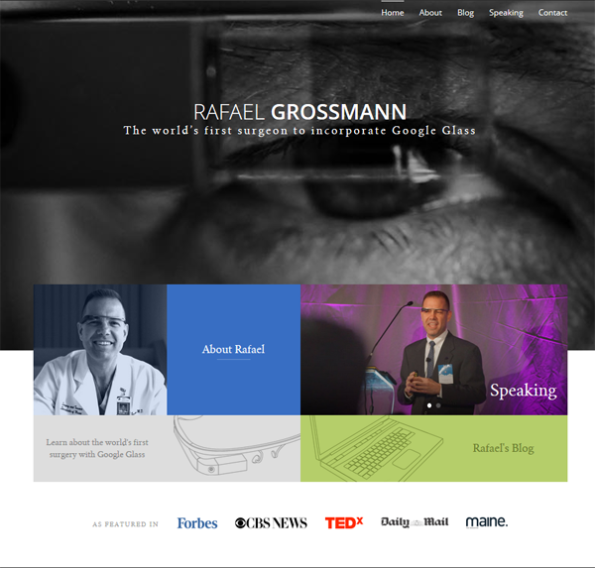 Please stop by my new website and leave a comment
Why I think that Google Glass is Not a failure
The interaction between medical providers and patients has been really compromised over the last few years.
According to Dr. Eric Topol ( as in his new book The Patient Will See You Now ), in the US, the average return visit to the doctors office lasts seven minutes and a new consultation twelve minutes”. Administrative requirements, reimbursement rules, government regulations and the inadequate use of technology, are among the factors to blame for this decline in the quality of medical care, at least in respect to the HUMAN quality of healthcare.
We have allowed technology to sequester what it meant to be a doctor, a healer-person connecting with the one seeking our help, our advice, our touch; a direct eye-to-eye link that could comfort and bring relief just by the mere act of taking the time to do it.
The SMART use of the RIGHT technology, can indeed improve the process, enhance the time and the interaction, paradoxically making us more, better HUMAN healers.
That’s one of the things that Google Glass can do in medicine.
Wearable devices, and specifically GoogleGlass, has started a tide of change and innovation, a true awakening of the minds, that only can be viewed as a major success, at least in that respect.
As a surgeon and innovator, the FIRST one to ever use Glass in the operating room, and NOT the only surgeon excited about this technology, I see this trend as the beginning of a new way to do medicine.
Thanks for Sharing it.
@ZGJR
Is GoogleGlass immortal?
Well, I do think so! In a way.
Would you say that the Ford Model T is dead?
Or did it actually represent the beginning of a revolution, the evolution of transportation?
You see, lately, there has been a lot of press regarding the demise of GoogleGlass. A few articles have explained that the time of Glass has passed, that developers are not interested anymore, that units are for sale in eBay.
Some have called it “the Segway of this era!”. I have read most of those editorials and releases. I have to say that I don’t agree with the basic premise of GoogleGlass being a failure.
As any new step, the first one is always shy and careful…Glass represents the next generation, the beginning of the future for the wearable device. Again, the beginning of a revolution, the evolution of the computing and communication platform. It was not invented in a day!


As a “pioneer” device, a “pseudo-beta” product ( a ready-product, not ready for the general public but instead for a very select group of skilled individuals in specific disciplines), Glass has awaken the imagination and creativity of the technologic community, the industry and the geeks out there.
I think that we all like he idea of having a “wearable” device in our forehead, as part of us, almost integrated with our selves, able to allow us to stay connected in the ways that we need or like, to perform our specific tasks more efficiently.
Glass has done that. It has shown that it is possible, and that the road to an ideal and trouble-free device is still being travelled.
Yes, we all agree that GoogleGlass is not perfect, in fact, it is far from it.
But we all remember the amazement of the first time when we saw the screen projected in front of our eye, and the awesomeness of navigating a menu with our voice, or listening to it without a headphone.
We all concur that the battery is poor, the connectivity slow, the voice recognition fair to good, the heating issues feel wrong and that for the day-to-day routine, is definitively not ready…but that’s not the point.
Glass represents the leap to something better, to a way of not texting with our fat fingers, bending our neck down to a screen or bringing a hand up to our ears. A way to look up and tap into vast human knowledge, available in the internet, just by talking aloud.
Glass will allow us to stand up again (like humans do), to speak our commands, to look directly at the eyes of our patients, not turning our backs to them looking at the other screen, or typing orders in.
If anything, it will allow us to connect in a more direct, personal and human way, in those times when we have to use technology.
In a recent article, Noor Siddiqui, COO and co-founder of Remedy ( http://remedyonglass.com ) quoted:
“Google Glass broke through that mental block, and got doctors to rethink the big clunky computers in our offices… that maybe it would make for a better bedside relationship if we turned away from those computers and got close to our patients again,” Siddiqui said. “…And what’s great is, now that doctors are thinking that way, it’s not about Google Glass anymore.”
I trust that Google is working in the next generation of Glass, and I know that it will be better, and that the feedback and outcries of those with and without faith will be addressed in that next device.We will be surprised.
Let’s wait and see what the future is going to be like.

Stats

Blogs I Follow



 @ZGJR Blog